
I’m excited to share news that Minx has been shortlisted for the John Pollard Foundation International Poetry Prize. The prize is awarded annually for an outstanding debut collection of poetry in the English language.
Since Minx was published by Chatto and Windus for Penguin Random House in March 2025 it has been such a privilege to read at events across the country, sharing stages with poets I admire and bringing Minx to new readers. It is an honour to be shortlisted alongside Dane Holt: Father’s Father’s Father (Carcanet Press), Michael Mullen: goonie (Corsair), Abu Bakr Sadiq: Leaked Footages (University of Nebraska Press), Darby Price: All The Lands We Inherit (Black Lawrence Press).
To whet your appetite for a little Minxiness visit the Chatto page, or download the audiobook and have me read it to you. You can also find Minx at… Minx by Karen Downs-Barton | Foyles, Bookshop.org, Amazon, Blackwells,
‘Don’t worry, I’m here in the house where every room has a name, but children’s names are often forgotten’
Heart-breaking yet uplifting, this lyrical evocation of an Anglo-Romani childhood on the edge of society marks the arrival of a vital new voice.
MINX draws us into the vibrant but precarious world of a multi-racial Romani family, whose troubled mother struggles to support her two girls on the proceeds of her shadowy nighttime work. The sisters develop a powerful bond, which helps them survive once they’re taken into care, under the punishing regime of a children’s home that separates them.
Through a series of daring experiments with form and narrative, MINX captures how it feels to be caught between a culture whose traditional ways are being lost and a wider society that despises them. With a verve and playfulness that belies their pain, these poems explore what it means to belong: the search for a language and heritage erratically passed on and the cost of being forcibly assimilated.
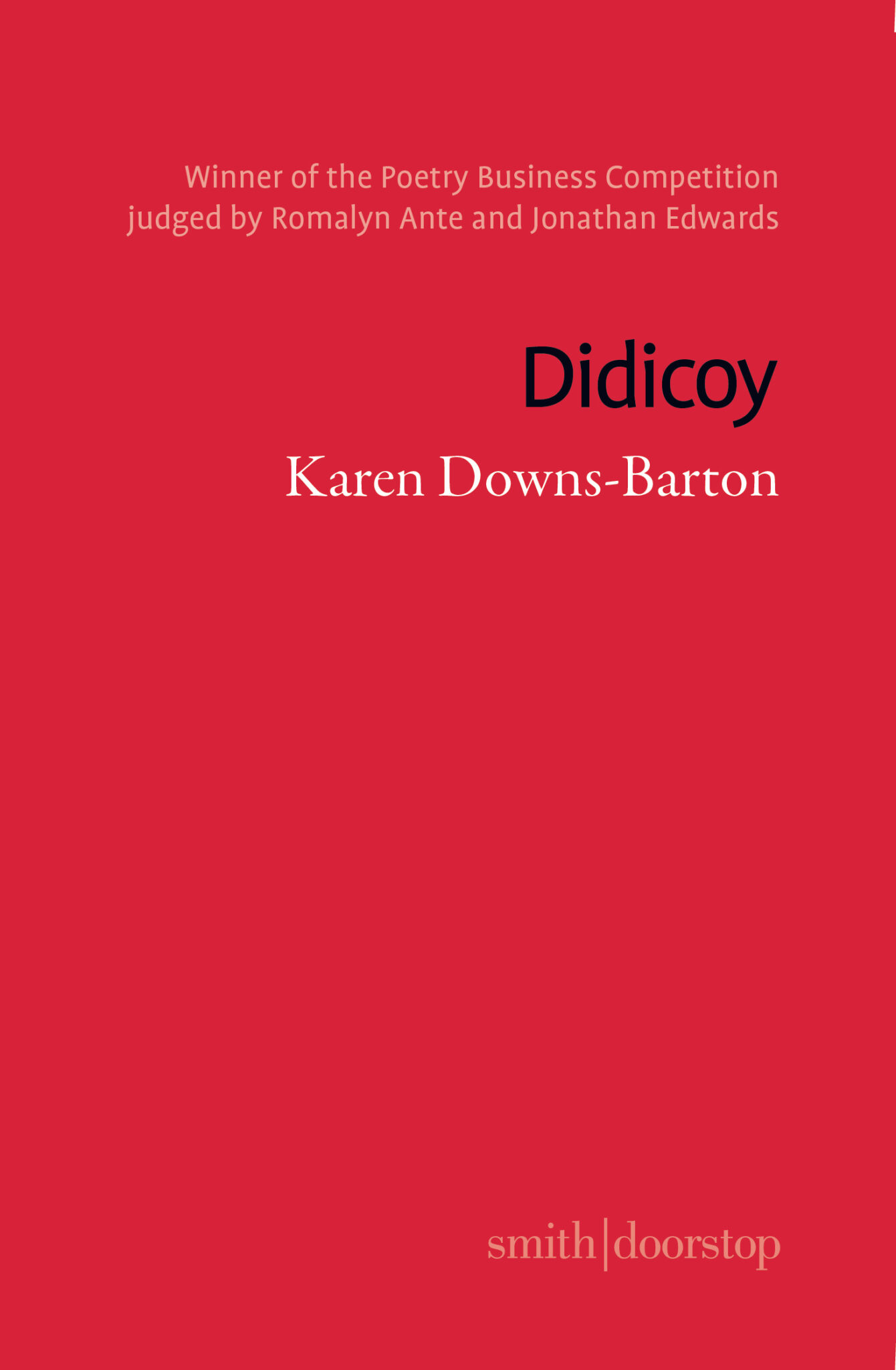
- Didicoy, I’m delighted to announce that Didicoy is the Poetry Book Society recommended pamphlet for summer 23.
It can be purchased through The Poetry Book Society / The Poetry Business / Amazon / W.H.Smith / Blackwells
- I will be giving a paper: Of Marginalia and Filling the Vampire’s Mirror: re/presenting journeys into creative self-representation against legacies of bordered imaginations, at Bielefeld University, at the “Transnational Migration in Romani History: Agency, Media, and Policing” conference, 6th – 8th March.
- The North issue 68. It’s wonderful to be published alongside so many writers I admire.
- Creative Future’s anthology. I’m delighted to announce that I was awarded the silver prize in poetry at the 2022 Creative Future Writers’ Award.
- Longlisted for the Ivan Juritz prize for modernist text
- Wagtail The Roma Women’s Poetry Anthology, ed. Jo Clement.
- Winner of the Cosmo Davenport-Hines Poetry Competition 2021, Published in Wild Court
- The North, Issue 65
- Tears in the Fence, Issue 73
- Rattle, Issue 71
- Tears in the Fence, Issue 72
- Ink, Sweat & Tears
- I Am Not A Silent Poet
- Petrichor Journal
- Missing Persons : Reflections on Dementia, Beatlick Press, Anthology
- Night Picnic, Volume 2, Issue 1
- Smuese, Summer 2017
- Three Drops From a Cauldron issue 2
- Persian Sugar in English Tea, Volume iii (in Farsi and English)
- Pennsylvania English, Volume 39.1
- Unlost Journal
- Otoliths, Issue 55
- Star 82 Review, Issue 4.4
- Otoliths, Issue forty-seven
- Thank You For Swallowing
- Thank You For Swallowing
- Thank You For Swallowing

This poem uses a form that I working with extensively in my PhD. In it I explore experiential material in both Angloromanes and English.
The Traditions We Bring With Us in a Confluence of Reds and Silks
Winner of the 2021 Cosmo Davenport-Hines poetry competition.

Published by Rattle, this poem with audio clip is taken from my recently completed MA thesis. It highlights the experience of many children taken into state care where personal belongings, like the children themselves, became part of a collective resource.
 Karen Downs-Barton